Friday, January 2

Quadrature

I lied again, I'm sorry. I'll try and post at least one more time during my elongated period of doing nothing. That very well could be a lie, but I'm going to try anyway.

I just got a book about famous math axioms for Christmas, and I saw something kind of cool in there. That reminded me of my promise during Thanksgiving to post, which I obviously broke. Sorry about that again.

~~~~~~~~~~

A really, really long time ago, the ancient Greeks were obsessed with geometry and number theory. This led to the idea of quadrature, the idea that for a (usually arbitrary) figure, a square could be constructed off of that figure with an area equal to it. For example, if you wanted a quadrature of a 9x4 rectangle, you would have to construct a square with side length 6. However, that's not really the point of quadrature-- you're supposed to be able to do it with an arbitrary figure.

Another thing to note is the nature of the constructions. You have to do it with only a straightedge and a compass, with no angles or lengths measurable. However, before we start, there are a lot of simple, pre-established things you can do with your two tools, so when I say "construct a midpoint" or something like that, just assume for the sake of the conversation (monologue, really) that it's possible, no questions asked. OK? OK.

~~~~~~~~~~

The first thing you need to learn is rectangles. They're pretty easy.

1. You have your arbitrary rectangle, ABCD.
2. Extend the edges from corner D to a reasonably long length.
3. Construct a circle with center D and radius CD. (The red dotted circle)
4. Mark point E where BD's extension and the circle intersect.
4. Construct F as the midpoint of BE.
5. Construct a circle with center F and radii BF and EF. (The blue dotted circle)
6. Mark point G where CD's extension and circle F intersect.
7. Construct a square with side DG. This square has the same area as ABCD.

~~~~~~~~~~~

Squaring the triangle is just building off of the rectangle.
1. Start with your arbitrary triangle, ABC.
2. Construct the altitude to point C.
3. Construct the midpoint of the altitude.
4. Construct the rectangle with height ED and base AB.
             At this point, compare on the basic formulae for the areas of a triangle and a rectangle, A=b*h/2   and    A=bh. One way to make the areas equal would haves the bases the same length and the height of the triangle be twice that of the rectangle. This is exactly what we have already constructed.
             From here you can just square the rectangle and everything's hunky-dory.

~~~~~~~~~~~~

Much more annoying is the arbitrary polygon itself.
In this case, we have ourselves a random heptagon. It doesn't look very quadrable, in my opinion. In fact, it looks like a mass of lines connected together. But wait! Look at what happens:
And now we have 5 triangles with areas V, W, X, Y, and Z. And we already know how to square those.
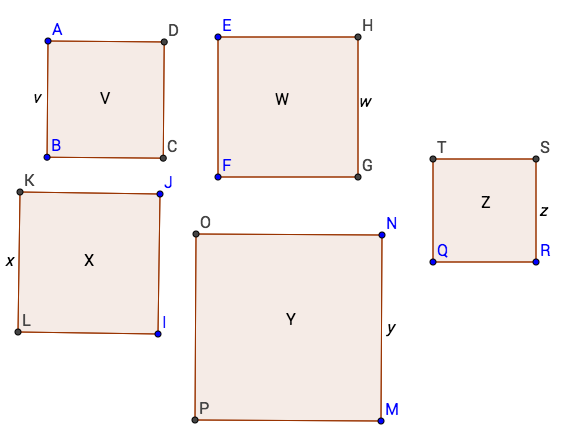
Now we have five squares with side lengths v, w, x, y, and z, the square roots of their capital letters. That's a good thing and a bad thing, because finally have a square, but too many of them. This is where we get to the interesting part.

At this point, think about the Pythagorean theorem--   a^2+b^2=c^2.

In the diagram:
w^2 + v^2 = a^2   and   a^2 + x^2 = b^2   , so
b^2 = w^2 + v^2 + x^2 = W + V + X

And:
b^2 = w^2 + v^2 + x^2   and   b^2 + y^2 = c^2  , so
c^2 = w^2 + v^2 + x^2 + y^2 = W + V + X + Y

If you don't see where this is going, then I'll explain it. Basically, by the Pythagorean theorem, a square with side length a would have and area of W+V, a square with side length b would have an area of W+V+X, and so on. Therefore, the area of a square with side length d would be equal to the sum of the areas of the smaller squares, and those are equal to the sum of the triangles, which is the area of the polygon. Neato!

~~~~~~~~~~~~

I'll continue this post tomorrow, don't worry.

Sunday, November 23

**UPDATE** and some random stuff

So it's been a WHILE

I started this post in September, and I was so close to finishing it, but I obviously forgot to actually post it! I've had actually NO time to do anything since maybe September, and I'm still really tired right now because I had a competition that was a couple of hours away, and I had to do stuff, and yeah.

I'm probably going to past at least 2 more times over Thanksgiving break, so don't worry about consistency. On second thought, worry about consistency, because you know it's really bad.

Let's get into the post.

~~~~~~~~~~~~

Prove that the square root of two is irrational.

What we're going to do here is assume that the opposite is true: Sqrt(2) is rational. By that logic, Sqrt(2) can be written as the fraction (a/b), where (a) and (b) are integers. Let's also assume that the fraction is simplified to its lowest terms. If it is, then both of them can't be even-- it could be simplified more.

If (a/b)=2, then (a^2/b^2)=2. Multiplying both sides by (b^2), you get (a^2)=2(b^2). Therefore (a) is even.

Because both (a) and (b) can't be even, then proving that (b) is even would prove that Sqrt(2) is irrational.

Since a is even, we can write (a) as (2*k), where k is half of a. Therefore:
(2k)^2=2(b^2)
4(k^2)=2(b^2)
2(k^2)=(b^2)

So b is even too which proves that Sqrt(2) is irrational.

~~~~~~~~~~~~

Prove that there are an infinite amount of prime numbers.

For this one, we're going to do the same thing- assume the opposite. There 'are' a finite amount of prime numbers.

If that's true, then we can multiply all of the prime numbers together to get some number c.

However, c+1 must be prime, because every prime number would have a remainder of 1 when dividing it. So that kind of proves it wrong, and it's a relatively easy proof.

~~~~~~~~~~~~~

Stay coolio,
John

Tuesday, September 9

Answers to the Diabolical Quiz

Did you get the answers? We'll see, I guess.

1. 144
2. 2
3. True
4. 2
5. False
6. 24
7. False
8. -12
9. True
10. -16

Believe me, there IS a way to solve this quiz. I just don't want to type it all.

Stay coolio,
John
~~~~~~~~~~~~~
PS- These are the answers to the quiz I posted last month. I'm really sorry that I haven't posted, but it's been a looooooooong couple of weeks for me. I will post tomorrow (or Thursday?), but I don't know. I have a lot of work to do, and I have to make this second on my list of priorities. But I promise I will post sometime this week. Thanks!

Monday, August 11

Diabolical Quiz About this Quiz

Time for another Problems w/John!!!!!!!!! You will hate me after this set.

1. What is the sum of all of the numerical answers of this quiz, including this one?
2. How many of these answers are "true"?
3. True or false: Question 1 has the highest numerical answer of this quiz.
4. How many answers are the same as this one, including this one?
5. True or false: All of the numerical answers are positive.
6. What is the average of all the numbers in this quiz, including this one?
7. True or false: The answer to Question 4 is greater than Question 2.
8. What is Question 1's answer divided by Question 8's?
9. True or false: The answer to question 6 is equal to the difference between answers 2 and 4, minus the product of answers 8 and 4.
10. What is the answer to this godforsaken question?

I'll put up answers on Wednesday.

Sorry I couldn't post last week, I was in Europe (land of the bad Internet). But honestly, not complaining.

Stay coolio,
John

Saturday, July 26

Hangman

Hey!

Imagine a man is convicted of murder and is sentenced to death one Saturday. The judge states that the man will be hanged sometime the next week, but the date will be a surprise-- the man won't know what day he is hanged until the noon of that day.

When the prisoner returns to his cell, he is ecstatic. Think about it: it can't be on a Saturday, because it is the last day of the week that he could be hanged on and therefore not a surprise. And if it was on Friday, he could be sure it was that day because Saturday has already been ruled out and therefore makes Friday the last possible day. So on and so forth until no day can he be hanged.

However, on Thursday, he is informed that he will be hanged. This comes as a complete surprise to him, contrary to his logic.

Consider this carefully. Is it a true paradox?

~~~~~~~~~~~~

Sorry for the short post. I'll put up an answer sometime next week, along with another post. Honestly, it's been a bit hard to do the blog, mainly because I get one hour every day to use my computer-- including free time, a research project that I have to do, and the blog.

I'll get you next week!

Stay coolio,
John

NEXT WEEK: Something Different

Friday, July 18

Ramsey Theory

Consider this problem:

Let's say that there are some people in a room for which some of them know each other and others do not. How many people must there be to make sure that either 3 of them are strangers to each other, or 3 have all met each other?

Another way to consider this problem is:

There are some points in a space, each connected by line segments to all of the other points. If each segment is either blue or red, then how many points must there be to ensure that there is one full triangle (with vertices on the points) outlined by all blue or all red?

In theory, these problems are exactly the same. The points are obviously people, and the color of the lines represents whether they know each other. If one color forms a triangle, three people either know each other or are total strangers to one another. Simple, right?


Anyway, the answer is 6 people. This is called the Ramsey number for two-colored triangles, written as:
R(3,3)=6

Let's call a complete graph (where all points are connected) with n points Kn. For Ramsey notation, the number of values in the parentheses represent the number of colors; the values themselves signify the graphs that we're trying to force. So R(3,6)=18 would be two colored, either forcing a red triangle or a blue K6.

Here are the Ramsey numbers that we know for now:
3, 3 = 6
3, 3, 3 = 17
3, 4 = 9
3, 5 = 14
4, 4 = 18
3, 6 = 18
3, 7 = 23
3, 8 = 28
3, 9 = 36
4, 5 = 25
6, 7 = 298

But then there are the irregular graphs, like straight lines and bowties and things like that. Well, thank you, Stefan Burr!

Sunday, July 13

Crafts Time (cont.)

Sorry, I just want to make a note on the last post I made, about the matchbox computer.

~~~~~~~~~~

Once upon a time, there was a guy named Donald Michie. When he was in WWII, he wanted to take Japanese and go fight on the Pacific front. Naturally, however, the class was full, and he did not sign up in time. However, he was not fazed in his war effort! He was recruited to help solve the enigmatic messages of the German army, and found that he was a natural in computer analysis. He began to work harder towards the study of artificial intelligence.

Within 20 years later, he invented the tic-tac-toe MENACE. MENACE was the Matchbox Educable Naughts And Crosses Engine, one of the first perfect-able robots to play the game of tic tac toe. He made the machine by diagramming all of the possible board states on 304 separate matchboxes. Although there are 19,683 possible board layouts*, Michie reduced this number to 304 by taking rotations, mirror images, and winning positions into account, thus reducing the number by over 98%.

*If you think about it, each of the 9 squares can be in one of three states: blank, X, or O. 3^9=19683.

~~~~~~~~~~~~

Stay coolio,
John

Tuesday, July 8

Crafts Time

IT'S FUN DAY MONDAY OMG SO EXCITED!!!!!!!
So I've been at the beach for 4 days now, and that of course means a lot of reading for those less inclined to enter the water. And so I learned something new:

~~~~~~~~~

How to Make a Hexapawn Educable Robot (HER)
Materials:
1) 24 Matchboxes or Similar Containers (Preferably blank)
2) 3-4 Bags of M&Ms
3) Paper
4) 4 Colored Sharpies (Orange, Blue, Green, Red, Brown, and/or Yellow)
5) 3 Pennies (or other coins)
6) 3 Dimes (or other coins)
Procedure:
1) Copy these diagrams onto the matchboxes:
2) On each of the diagrams, color all the arrows in each diagram differently.
3) Open the bags of M&Ms and sort them by color.
4) Eat the two colors of M&Ms whose corresponding Sharpie you do not have. For example, if you don't have a yellow or brown Sharpie, eat all the yellow and brown M&Ms.
5) Put an M&M in each box for the number and color of the arrows on it. For example, if there is a 
    red arrow on the box, put in a red M&M.
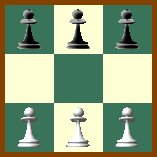
6) Draw a three-by-three grid and put the coins on opposite sides, like so:

You are now ready to face your computer in Hexapawn!

~~~~~~~~~~

How to Play Hexapawn:

Hexapawn is a one on one game that you play against HER in order to teach it how to win! To win, you must either:
1) Capture all of your opponent's pawns,
2) Get one of your pawns to the opposite side, or
3) Be the last player to be able to move.
Your pawns move the same way that they would in chess-- they can only move forward, except they must capture diagonally-- except there are no double moves and en-passants. Good luck!

~~~~~~~~~~

How to Operate your HER:

First, arrange the matchboxes as shown in the diagram above. This makes the game run smoother.
Then you can start the game. You make your move first.

Here's how you operate the robot:
1) Find the matchbox whose diagram is either the same as the current board position or a mirror image.
2) Shake the matchbox to mix the M&Ms.
3) With your eyes closed, open the matchbox and pick a random M&M.
4) Place the M&M on top of the matchbox and observe the color of the M&M.
5) Find the corresponding arrow for the color of the M&M.
6) Make the move as indicated by the arrow.

3.5*) If there are no M&Ms in the box, the robot automatically loses.

The education of the robot is based on a reward/punishment system. When the robot wins the game, the M&Ms that are on top of the boxes are placed back inside. When it loses, take away the M&M that represents the last move that the robot made; *if a box is empty, the HER loses and you take away the M&M on last move's box.

~~~~~~~~~~

How the HER Works

Imagine a huge probability tree that represents the outcomes of each game. Each splitting of branches represents the robot's decision-- and so the end of a branch is either a win or a loss for the robot. When you remove M&Ms, you are, in essence, cutting off the branches in which the robot loses. The robot has a big advantage by going second, and so it will eventually have the ability to win every game it plays.

~~~~~~~~~~~

Stay coolio,
John

NEXT WEEK: Ramsey Numbers

Tuesday, July 1

Hailstones (The Collatz Conjecture)

Hey guys, I'm back from camp with a TON of new ideas. I got a bunch of math books as a graduation present (which would be a really mean present if I wasn't myself), and I got some new topics to discuss.

~~~~~~~~~~

In the science of the hydrosphere, we all know that water molecules present in air all eventually return to the Earth in the form of precipitation. One of the forms thereof is hail, which forms in heavy storms when liquid rain freezes onto snow pellets and begins to form solid lumps.

Let's say that layers of the atmosphere are marked by numbers, starting with one as the ground. The goal of a hailstone is, obviously to reach one.

The process that determines the path of a hailstone is this:
1) If a hailstone reaches level n, and n is odd, then the hailstone is caught by a gust of wind and shoots up to level 3n+1.
2) If n is even, then there is no wind and the hailstone falls to n/2.
3) This process is continued upon itself until n reaches 1.
For any positive integer from which the hailstone (n) begins, does n reach 1?

This can also be stated as:

~~~~~~~~~~

FACTS:

1. The sequence always ends [...] 16, 8, 4, 2, 1.
2. The conjecture has been proved up to about 5476377146882523136.
3. The sequence always returns to one if n is a power of 2.
4. The recurrence is undecidable (it cannot be solved by an algorithm).
5. Once the hailstone reaches 16, the hailstone is set into an infinite loop around (4,2,1).
6. Most diagrams are created in reverse.

Up to 20 iterations. Ends with one in the center.

~~~~~~~~~~~~~

Hey guys! It's good to be back. From now on, I'm going to try to have one post every Monday. I have so much to talk about, but I don't want to waste all of my ideas now! We'll see what happens later, I guess.

Stay coolio,
John

NEXT WEEK: More on Game Theory

Thursday, May 29

Illustrated Multiplication! (AKA Educational Satire)

Ever had trouble multiplying fast? Do you just want to doodle in math class? We can help you!

Try out our new product, Illustrated Math! It's easy as 'pi' and we'd LOVE to give it to you for free!

Here's a song to celebrate your discovery of this easy new trick!


How unnecessary was that?! But as an infomercial, we need some cheesy background music!

It's EASY!

Let's do a demo!

Let's multiply 51 and 23. First, we draw lines representing digits.
Great! Now let's separate the columns and count up the number of intersections in each column!

Fantastic! All we have to do is add it up!

                                                                                              + 3
                                                                                      + 1  7
                                                                                  + 1  0
                                                                                  = 1  1  7  3
Let's check to see if our answer is correct!


Wow! Shazam! Fantabulous!

It's FAST!

Studies show that this new, cool multiplication trick can save you –50% time when compared against regular multiplying! This is mainly because some idiot wrote the answer on the paper during the first of the regular trials and we didn't bother to replace it!

It's CHEAP!

Even though this is more of a concept than a product, we can give it to you for free!* (This doesn't include the $19.99 shipping and handling, the complimentary $199.99 gift pack we'll send you, or the medical bill you'll need to pay after using this product! Don't read the subtext!) 

It WORKS!

By the FOIL method straight from middle school algebra! We can't believe you didn't figure this out yourselves, you disgraces to all humanity! (Even though we didn't figure it out either. Shh, don't tell)

And it's probably harmless!

The 2% of subjects that survived reported that it had really changed their lives for better or worse! You don't want to know which!

CALL 1-800-I-SEE-U-PN to order NOW!

Make checks payable to Bad Products Inc. ©.

*Batteries, Medical Consultation, and Michael Jackson not included.

The more common and l side effects may include Stockholm Syndrome, Bruce Jenner approximation syndrome, organ inversion, and zombification. At the risk of getting sued we can't tell you the nastier ones or you wouldn't buy this product.


~~~~~~~~~~


Hey everybody! I'm BACK! Sorry for not posting-- I've had a nice little month of studying for exams. I actually finished a post two weeks ago and, of course, the school server was shut down and it didn't work. I'm going to post that next week to make up for a), my long absence from your world, and b), the nastiness of this post.

Sorry for not posting earlier, but April Showers bring the overpowering stench of May exams!

Stay coolio,
John

IMPORTANT NOTE- Tragically, I'm not going to be able to post very much this summer, because it's summer. I promise I'll get back to you in late June or early July!

Wednesday, May 7

Probs of the Week v. 3.0

Yep. It's back.

1. Based on the following facts:
ab=1
b+c=0
b+c+d=0
bc=-9
c+a<d
What is a+b?

2. The first term of a geometric sequence is 12. If the geometric mean of the first 3 terms is 18, what's the third?

3. If three competing products have loyalties of 20%, 60%, and 80%, and half of the customers that switch go to one of the other products, then how many customers will go to each after they begin marketing regularly?

4. How many distinct integers are in the set of differences between numbers of the set, {1,3,5,7,9,10, 11,13}?

5. How much wood could a woodchuck chuck if a woodchuck could chuck wood?

~~~~~~~~~~~~~

1. Let's gather our info:
a) a is the reciprocal of b, and the negative reciprocal of c
b) b is equal to negative c, and their product is -9
c) d is equal to 0, and is greater than the sum of a and c.
We can draw the conclusion that:
d) b and c are equal to 3 and -3, in some order
e) a is equal to either -1/3 or 1/3
f) a+c=-3+(1/3)<0
g) a=1/3, b=3, c=-3
h) a+b=3+(1/3)=10/3

2. By definition, the geometric mean is the second term. The ratio of 18 to 12 is 3/2; 3/2 times 18 is 27.

3. The matrix is...
[ 0.2  0.4  0.4]
[ 0.2  0.6  0.2]
[ 0.1  0.1  0.8]
To the power of 30 it reaches
[ 0.1429  0.2857  0.5714]
[ 0.1429  0.2857  0.5714]
[ 0.1429  0.2857  0.5714]

4. Let's remove the 10 for now. The differences between the numbers are the even integers from 2 to 12-- that makes 6. Now, the 10 is different- the difference between it and the other numbers is always odd, from one to nine. Six plus five, if you couldn't figure out, is 11.

5. Enough to spray splinters into your tongue... who really cares? According to a website I found, the answer is 22 cubic inches. That's more of a biology problem anyway.

So YEAH!

Bye sweet children!
John

PS: We're learning about conditionals and logic problems in class today, and it's taking absurdly long for some of my friends to figure it out. Oh, sweet rationale... where have you run off to now?

Tuesday, May 6

Science Blog- Friend of the Devil is a Friend of Mine

Go follow this guy!
Ben's Science Blog
For updates and interesting posts on astronomy, physics, geology, and every other science topic you could ever imagine, just consult this blog. He posts almost regularly, so he'll really keep you occupied with his mind-blowing facts.
~~~~~~~~~
This is just a quick update- he did me a favor so I did him one in return. Sha-zam!

Monday, May 5

Double-Dog-Derivatives

What happens when the derivative of a function is itself?

As you may already know, a derivative is just a fancy little term for slopes of tangent lines. Or slopes of points, for people who view it differently. Anyway...

There are certain functions whose derivative is itself. What are some of these?

~~~~~~~~~

"e^x" is the only exponential function that has this property. This is just one of the many amazing applications of Euler's number.

"0" is another, but anybody could figure that one out.

"sin(x)" and "cos(x)" have their derivatives every fourth time.

"cosh(x)" and "sinh(x)" also have their own derivatives.

Just a note-- for "log x", the second derivative approaches the original when the base approaches infinity.

No polynomial function works, according to this theorem:
For any polynomial function "f(x)=c*x^n", its derivative is "c*n*x^(n-1)". So even if the coefficient is the same, the degree is offset by one.

~~~~~~~~~~

Sorry for the short post. I started the post, then kind of realized that I didn't really have much to work with...
Hang in there, people! I have final exams coming up, so I might not post much. Just wait, OK?

Stay coolio,
John

Saturday, May 3

The Prime Test

A while ago, some famous math guys came up with a new theorem to test for primes. That is, you can use this test to find out if any number is prime. The test is much better to use with smaller numbers, because the bigger a number, the longer it takes to run this test.
By the way, I saw this on a Youtube video, but I noticed a pattern a while ago related to this.

~~~~~~~~~~

Let's go back to Pascal's Triangle. Pascal's Triangle is a sort of array of numbers starting at one at the top, and each number is the sum of the two numbers above it. It looks like this:
Now take a look at the rows whose second number is prime. All of the numbers following it are divisible by it-- excluding 1. And all of the composite numbers don't have this property.

You also have probably heard of the Binomial Theorem. This theorem states that all coefficients of the expansion of:
(x+1)^n      (or (a+b)^n)
are the terms of the nth row of Pascal's Triangle, which is also a cool property.
So if we combine our previous discovery and the Binomial Theorem, we can get:
"All of the coefficients of the expansion of (x+1)^n are divisible by n if and only if n is prime, excluding the coefficient one of the first and last terms."
And if we get rid of that last part and reverse that, we get:
"Any whole number n is prime if all of the coefficients of
(x+1)^n - x^n - 1
are divisible by n."

Let's try it out, hmm?
7: coefficients are 7, 21, 35, 35, 21, 7    yes
10: 10, 45, 120, 210, 252, 210, 120, 45, 10   no

It works!

I just thought that this was a really interesting breakthrough.

Sty coolio,
John

Monday, April 21

Transition Matrices

These are, like, some of my favorite things in matrices, and maybe in math itself. Pay attention, yo! This is actually really useful for weather predictions, customer loyalty, and so many other things that it will blow your MIND OFF.

If you don't know yet, matrices are basically tables of data that math people use to perform operations. Happy Easter!
~~~~~~

1) Somewhere over the rainbow, there's a place with really weird weather. Let's say that:
9 rainy days out of 10 are followed by non-rainy days.
3 non-rainy days out of 10 are followed by rainy days.
By that logic, what's the chance that any particular day will be rainy?

If we try to do it the hard way, we have to use the probabilities as a result of what the previous day is and therefore the day before that, and therefore the day before THAT, and on and on until we get lost in the past and we can't really be happy anymore. But the sequence HAS to converge somewhere! I think we both can figure out right now it's possible, and I wouldn't give you a trick question about this anyway.
Speaking of the past, you're feeling slightly nostalgic for high-school math classes. One topic seems to shout out at you in particular: network matrices. You remember that you can organize a huge network of different pathways using a single matrix, with each datum representing a number of pathways from one point to another.
Being a good little nostalgic person, you decide to do this for yourself.
So there you have it. You've managed to be a clean freak. What do we do now?
Let's say we know what the weather is today. Then we also know the weather probabilities tomorrow. And, by reapplying the probability matrix again, we can figure out the day after that! The matrix squared is:
0.76   0.24
0.72   0.28
So that's the probabilities for the day after tomorrow. We can do this again and again, so where does it converge?
[M]^30=
0.75   0.25
0.75   0.25
In this case, we can assume that 30 is an artificial infinity. Referring to this new matrix, we see that after "infinity," there is a 1/4 chance of sun. Since infinity can technically count as any random day, as any operation performed on infinity is nullified, we see that the chance that any random day will be rainy is exactly 1/4. Finally!

The cool thing about these transition matrices is that you can apply them to other data.

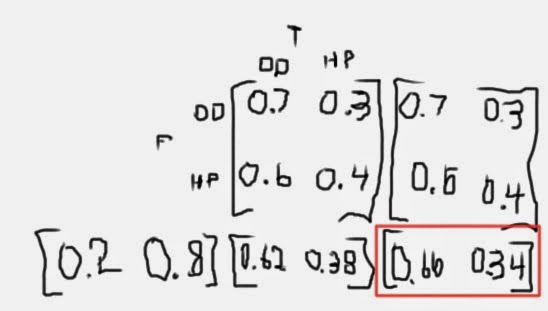
2) Two competing fast-food chains, O'Donald's and Hamburger Queen, have respective customer loyalties of 70% and 60%. If, when they open (at the same time), 80% of all customers go to Burger King, how many of the customers will go to O'Donalds after two trips?
So about 2/3 of the customers are going to O-Dees after two trips.

This repetition of matrices to find data is called a Markov Chain. Markov Chains are statistic models whose event probabilities are based on the previous event.

The matrix [(0.75, 0.25) (0.75, 0.25)] from the first problem is called a steady-state matrix, because it is the convergence of the transition matrix and cannot be altered further by the transition matrix.

Transition matrices and network matrices are used in a LOT of things: communication, business, competitions, ecology, psychology, transportation, and even biology. 

~~~~~~~~

Crazy, right? I hope you like this as much as I do.

Stay coolio
John

Wednesday, April 9

Infinite Series (and Sequences) (cont.) (see first post) (parentheses)

When nobody knew anything about my blog except for my friend and some German Menschen (some of my first internet traffic came via Germany, strangely enough), I had a post about infinite serieses*. I found something interesting that my math teacher recommended I put in here, and as that topic was infinite sequences, I decided to put it in here.

Here is one of the problems:
Let's make a house of cards!
Write a formula for the sequence representing the number of cards at each stage.
First method is to make a chart.
Stage-     1      2      3      4...
Cards-    2      7     15    26...
                 +5    +8   +11
Each stage increases by 3 more than the last increase. Now I'm sure there's an algebraic way to solve it from there, but my method is much more interesting.
Look at the direction that the cards face-- I marked them with lines. What's the sequence that the directions make?
Stage-   1    2    3    4
Dir 1-   1    3    6    10
Dir 2-   1    3    6    10
Dir 3-   0    1    3     6
We know those sequences! Those are triangular numbers, denoted by (y=n(n+1)/2). Because one is offset to the left, we modify the formula a bit to (y=n(n-1)/2). By definition, we can add these three formulas together to get:
y=n(3n+1)/2


Another thing we thought about in class were divergent sequences with really weird sums. For example, 1+2+3+4... is equal to -1/12, while 1+2+4+8... is equal to -1. Here's why:
For the first, imagine three sequences:
S1=1-1+1-1+1-1+1...
S2=1-2+3-4+5-6...
S=1+2+3+4+5...
Unfortunately, S1 orbits on the period of 1 and 0. So we have to use other methods. Watch this:
S1 + S1 =   1 - 1 + 1 - 1 + 1 - 1 ....
                      + 1 - 1 + 1 - 1 + 1
              =   1 + 0 + 0 + 0 + 0 + 0... = 1
So two times S1 is one, so S1 is 0.5.
And then, there's S2.
S2 + S2 =   1 - 2 + 3 - 4 + 5 - 6 + 7 ...
                      + 1 - 2 + 3 - 4 + 5 - 6 ...
              =   1 - 1 + 1 - 1 + 1 - 1 ...
Thereby establishing that S2 is 0.25.
Then watch this!
S - S2 =   1 + 2 + 3 + 4 + 5 + 6 + 7 ...
               -1 + 2 - 3  + 4 -  5 + 6 -  7
           = 4 + 8 + 12 + 16 + 20 + 24 + 28 ...
which is 4 times S. We end with:
S - 0.25 = 4S
S = -1/12
Wow! Amazing! Literally impossible!
There's probably some reason that it's not true, but who cares? It's just time to marvel at the effects of calculus on algebra!

The next one on the list (that my friend learned from a high school teacher) is
S = 1 + 2 + 4 + 8 + 16 + 32 + 64
And so we use the same method, in theory.
S - S = 1 + 2 + 4 + 8 + 16 + 32 + 64 ...
                - 1 -  2  - 4  -  8  -  16  - 32..
         = 1 + 1 + 2 + 4 + 8 + 16 + 32...
And so
S - S = S + 1
S = -1

Another impossible sum! If any people disagree they will be ridiculed forever! I'm kidding- just give me a reason that I understand.

Stay coolio,
John

PS.: This post took FOREVER

Friday, April 4

GAME THEORY

I was looking through a Barnes and Noble science section for a book on quantum theory (DON'T JUDGE), and I found a book entitled "Game Theory". I began to look through it and found it to be very interesting. Although I didn't find a good (and easy to understand) book on QT, I almost got the Game Theory.

In game theory, only two things define a game-
-there are two or more players...
-who interact to maximize a 'Utility'.

In games, Utility are the 'points'-- or, if no points, a numerical representation of the situation they're in. Usually it's an estimate.

Let's give an example.
There are two prisoners A and B. Together, they committed a crime for which they could get 10 years in prison. However, they are each offered a deal in which they can confess and testify against their partner (defect) or refuse to admit it (refuses). This is the deal to both of them:
a) If you defect and your friend refuses, you escape free and your friend gets 20 years.
b) If you both defect, you both get 5 years.
c) If you both refuse, you get 10 years.

Let's analyze!
If your friend will defect, your best option is to defect too, because it reduces your sentence by 15 years. However, if your friend will likely refuse, you should defect, as it will reduce your sentence by 10 years. Your best option is to defect, because the average between your possible sentences will reduce by 7.5 years than if you refuse. Think of it this way-
This is called a matrix, if you don't know. But I'm assuming that you do.

We could also plot it on a tree.
An interesting property of the PD is that the players technically do not interact-- it's what they do when they don't interact that makes it an interesting game.

There's a concept called Nash Equilibrium that's relatively important to game theory. From what I can tell, it's a situation where no players want to change their strategy. In a way, it means that they won't gain anything by changing their strategy.
A NE in Prisoner's Dilemma is, let's say, both players choose to defect. If either player decides to change their strategy, they'll lose.

There's also another game called Morra that you may have played. This is an interesting game that is played like rock-paper-scissors.
In Morra, only two players compete. So, on the count of whatever, each player holds up a number on their fingers from one to ten. If the sum of their numbers is even, one player wins; and vice versa.
Here's a chart I created-
Notice that the number they pick doesn't matter-– only if it's even or odd does.The odd player should do the opposite of the even player, but the even player should do the same as the odd. There is no real 'better strategy', unless you somehow read your opponent's mind, or predict the future.

Anyway, I guess that's it! There are tons of other good games-- Rock Paper Scissors, Nim, 2/3 the Average, and Fair Division (Cake Cutting). You acan look at them if you want.

Stay coolio, John

*PS: Sorry if this was a bad post-- Game Theory is extremely general*

Friday, March 28

Orbits!

OK, this is a really interesting post for me. Just stick with it, OK?

In math, there are two types of orbits:
1) An elliptical path traced by an object due to gravitational pull towards another object. AKA the orbit that you know.
2) A repetition of a function infinitely upon itself. (this term might be outdated- I found the lesson in a precalculus book at my college-aged cousins' house)

For orbit #1, an orbit is elliptical due to two factors:
1) Gravity is imperfect.
2) the way that an object enters (or forms in) the gravitational area.
Anyway, the point is that the object that it orbits around is a focus of that ellipse. The foci are the two points that determine the ellipse-- the sum of the distances from any point on the ellipse to each of the foci is constant.
If you think about it, the Sun isn't at the center of the solar system–– it's at one of the foci.
Here's a good problem about it.

Denying the laws of probability and physics itself, let's say the planets in our solar system are perfectly lined up to one side of the sun. The center of the ellipse is approximately 1.5 million km from the center of the sun. If Earth is at its closest point to the sun (148 million km), and the center of gravity of the solar system remains where it is no matter where the planets travel (which is a lie), what is the furthest point of Earth's orbit from the sun?
In the ellipse above, A and B are the foci, D is the center, and C and E are points on the major and minor axes respectively. 
Anyhow, in this case, AD is equal to 1.5 million kilometers and EA is equal to 148 million kilometers. The sun is at A and Earth is at E. 
Since the furthest point is basically the point on the other side of point B, the formula for the farthest point would be:
( (EA) + (AD) ) * 2 - (EA)
Which is about 151 million km, or an accurate-ish 93.8 million miles.

Another thing you might want to know about ellipses is that in the above example (pretend the scale is off), ED=AC=(AD)^2 + (CD)^2.

~~~~

Soooo, now to the other orbit.

Function orbits are similar to orbits: they go around and around a particular value. Now, to explain them.
Imagine a function f(x) for any value x1. Now imagine f(f(x1)). Then f(f(f(x1))). Continue this pattern until you are 106 years old. The orbit of f(x) for that value of x1 would be the infinite sequence 
x, f(x), f(f(x)).... on until you are 106. Or really, infinity years old. The last (or technically last) term of that sequence would be called the limit of the orbit, because the sequence would get infinitely close to the limit but not to the limit.
The limits are also called 'fixed points', because if x1 is equal to its limit, it goes automatically to the limit. Therefore, the limit becomes 'fixed', as its position never changes after the first term.
If you think about it, the fixed points are all on the line y=x, as shown for f(x)= sqrt(x):

In fact, this is a good function to show you something about.

For f(x)=sqrt(x):
For the x1 values of 0<x1<1, what is the limit?
For the x1 values of x>1, what is the limit?
As you can see, both limits to the domain containing non-fixed points are 1. So, 1 is an attracting limit while 0 is repelling.

There are a couple important uses of orbits.

What is the value of 1+(2/(1+(2/(1+(2/...
This is the limit of the orbit 1+(2/x). Calculating the value of the limit would be:
1+(2/x) = x
x^2 - x - 2 = 0
x= 2, -1
Since all of the signs are positive, the root must be positive 2.
*Note*- The above problem could be thought of as the limit of (2/(1+x)) plus one.
The easier way to explain population is through orbits. Population prediction is really important for people in government, and they use dynamic systems to answer their questions. Here's an example of a model:
f(x+1)= 4 * f(x) * (1 - f(x))
where f(x) is a decimal less than one representing the current population. This function is true because of four things:
1)–– (1-f(x)) is a representation of death, especially by starvation or sickness. This would be true because as population goes up, resources get used quicker and lead to a severe lack of supplies.
2)–– f(x) is a representation of birth, which also increases as the population increases. 
3)–– 4 is needed to multiply because 0.5 is lost twice when the other terms are multiplied.
4)–– The function is recursive because we're trying to find the population next year, not any general year.


~~~~~

Have fun pondering over what I'm trying to explain!

Stay coolio,
John

Wednesday, March 26

Your Least Favorite Post

That's right... we're doing
So here are some tips for using the ID's--

1) Memorize those formulae- esp. sum and difference identities.
2) Simplify to sines and cosines-- using algebra and reciprocal ID's. This is probably the most important step.
3) Use algebra to simplify to the least possible amount of terms.
4) Use a calculator or something to do the rest. (if solving for variable)

Usually, the point of the identities is to
a) prove an identity/theorem or
b) solve for a variable.


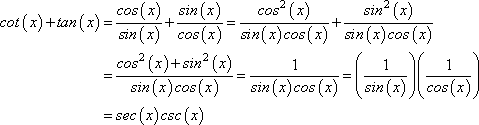
Like above, you have to use all of the identities, mostly reciprocals. 

Although it's one of the most annoying parts of math, it's definitely worth knowing.

Another way to solve it is graphing, but that takes away all the coolness of it. Basically, you can find if the graphs of (cot(x)+tan(x)) and (sec(x)csc(x)) are the same.

I might do something with functions and orbits later. Sorry for not posting in a while.

Stay coolio, John

Thursday, March 20

Late Pi Day

Pie? Like the food?

OK, you've probably heard that before, as Pi Day is now more conspicuous in terms of holidays. Happy 6-days-too-late-for-Pi Day!

The approximate ratios for pi are:
3 digits: 22/7
4 digits: 245/78
5 digits: 333/106
6 and 7 digits: 355/113
continued...
38 digits: 2,646,693,125,139,304,345 / 842,468,587,426,513,207
Well, quintillions are pretty accurate, right?

At digit 763, there are 6 nines in a row. This is the Feynman point.

To find the circumference of a circle the size of the universe to within the radius of a single proton, you only need 39 digits. Although that seems like a lot, it really isn't.

Chao Lu from China memorized 67900 digits of pi. Nice use of time, Chao! Especially considering the last fact!
A ten year old actually memorized 410 digits of pi. Either he felt the urge to learn all of them or his parents are gigantic perfectionists.

Pi is equal to...
6 * sqrt(sum (1-inf) (1/n^2) )
4 * (sum (1-inf) ((-1)^n /(2n+1)))

Although pi is determined by a ratio, it cannot be expressed using a ratio. Therefore, the circumference and/or the diameter must be irrational in a circle.

In the first six million digits of pi, five is the most common and zero is the least common. In the first million, five is the most common and seven is the least common.

Pi is technically mentioned in the bible- see 1 Kings 7:23.

Pi has been referenced in a huge amount of books, TV shows, and movies.

Extremely Cool Sites:
The Pi-search page- This finds certain strings of digits from the first 200 million digits of pi. Extremely cool website.
More Links

Keep calm and guess again!