Tuesday, July 8

Crafts Time

IT'S FUN DAY MONDAY OMG SO EXCITED!!!!!!!
So I've been at the beach for 4 days now, and that of course means a lot of reading for those less inclined to enter the water. And so I learned something new:

~~~~~~~~~

How to Make a Hexapawn Educable Robot (HER)
Materials:
1) 24 Matchboxes or Similar Containers (Preferably blank)
2) 3-4 Bags of M&Ms
3) Paper
4) 4 Colored Sharpies (Orange, Blue, Green, Red, Brown, and/or Yellow)
5) 3 Pennies (or other coins)
6) 3 Dimes (or other coins)
Procedure:
1) Copy these diagrams onto the matchboxes:
2) On each of the diagrams, color all the arrows in each diagram differently.
3) Open the bags of M&Ms and sort them by color.
4) Eat the two colors of M&Ms whose corresponding Sharpie you do not have. For example, if you don't have a yellow or brown Sharpie, eat all the yellow and brown M&Ms.
5) Put an M&M in each box for the number and color of the arrows on it. For example, if there is a 
    red arrow on the box, put in a red M&M.
6) Draw a three-by-three grid and put the coins on opposite sides, like so:
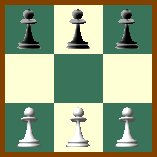
You are now ready to face your computer in Hexapawn!

~~~~~~~~~~

How to Play Hexapawn:

Hexapawn is a one on one game that you play against HER in order to teach it how to win! To win, you must either:
1) Capture all of your opponent's pawns,
2) Get one of your pawns to the opposite side, or
3) Be the last player to be able to move.
Your pawns move the same way that they would in chess-- they can only move forward, except they must capture diagonally-- except there are no double moves and en-passants. Good luck!

~~~~~~~~~~

How to Operate your HER:

First, arrange the matchboxes as shown in the diagram above. This makes the game run smoother.
Then you can start the game. You make your move first.

Here's how you operate the robot:
1) Find the matchbox whose diagram is either the same as the current board position or a mirror image.
2) Shake the matchbox to mix the M&Ms.
3) With your eyes closed, open the matchbox and pick a random M&M.
4) Place the M&M on top of the matchbox and observe the color of the M&M.
5) Find the corresponding arrow for the color of the M&M.
6) Make the move as indicated by the arrow.

3.5*) If there are no M&Ms in the box, the robot automatically loses.

The education of the robot is based on a reward/punishment system. When the robot wins the game, the M&Ms that are on top of the boxes are placed back inside. When it loses, take away the M&M that represents the last move that the robot made; *if a box is empty, the HER loses and you take away the M&M on last move's box.

~~~~~~~~~~

How the HER Works

Imagine a huge probability tree that represents the outcomes of each game. Each splitting of branches represents the robot's decision-- and so the end of a branch is either a win or a loss for the robot. When you remove M&Ms, you are, in essence, cutting off the branches in which the robot loses. The robot has a big advantage by going second, and so it will eventually have the ability to win every game it plays.

~~~~~~~~~~~

Stay coolio,
John

NEXT WEEK: Ramsey Numbers

Tuesday, July 1

Hailstones (The Collatz Conjecture)

Hey guys, I'm back from camp with a TON of new ideas. I got a bunch of math books as a graduation present (which would be a really mean present if I wasn't myself), and I got some new topics to discuss.

~~~~~~~~~~

In the science of the hydrosphere, we all know that water molecules present in air all eventually return to the Earth in the form of precipitation. One of the forms thereof is hail, which forms in heavy storms when liquid rain freezes onto snow pellets and begins to form solid lumps.

Let's say that layers of the atmosphere are marked by numbers, starting with one as the ground. The goal of a hailstone is, obviously to reach one.

The process that determines the path of a hailstone is this:
1) If a hailstone reaches level n, and n is odd, then the hailstone is caught by a gust of wind and shoots up to level 3n+1.
2) If n is even, then there is no wind and the hailstone falls to n/2.
3) This process is continued upon itself until n reaches 1.
For any positive integer from which the hailstone (n) begins, does n reach 1?

This can also be stated as:

~~~~~~~~~~

FACTS:

1. The sequence always ends [...] 16, 8, 4, 2, 1.
2. The conjecture has been proved up to about 5476377146882523136.
3. The sequence always returns to one if n is a power of 2.
4. The recurrence is undecidable (it cannot be solved by an algorithm).
5. Once the hailstone reaches 16, the hailstone is set into an infinite loop around (4,2,1).
6. Most diagrams are created in reverse.

Up to 20 iterations. Ends with one in the center.

~~~~~~~~~~~~~

Hey guys! It's good to be back. From now on, I'm going to try to have one post every Monday. I have so much to talk about, but I don't want to waste all of my ideas now! We'll see what happens later, I guess.

Stay coolio,
John

NEXT WEEK: More on Game Theory

Thursday, May 29

Illustrated Multiplication! (AKA Educational Satire)

Ever had trouble multiplying fast? Do you just want to doodle in math class? We can help you!

Try out our new product, Illustrated Math! It's easy as 'pi' and we'd LOVE to give it to you for free!

Here's a song to celebrate your discovery of this easy new trick!


How unnecessary was that?! But as an infomercial, we need some cheesy background music!

It's EASY!

Let's do a demo!

Let's multiply 51 and 23. First, we draw lines representing digits.
Great! Now let's separate the columns and count up the number of intersections in each column!

Fantastic! All we have to do is add it up!

                                                                                              + 3
                                                                                      + 1  7
                                                                                  + 1  0
                                                                                  = 1  1  7  3
Let's check to see if our answer is correct!


Wow! Shazam! Fantabulous!

It's FAST!

Studies show that this new, cool multiplication trick can save you –50% time when compared against regular multiplying! This is mainly because some idiot wrote the answer on the paper during the first of the regular trials and we didn't bother to replace it!

It's CHEAP!

Even though this is more of a concept than a product, we can give it to you for free!* (This doesn't include the $19.99 shipping and handling, the complimentary $199.99 gift pack we'll send you, or the medical bill you'll need to pay after using this product! Don't read the subtext!) 

It WORKS!

By the FOIL method straight from middle school algebra! We can't believe you didn't figure this out yourselves, you disgraces to all humanity! (Even though we didn't figure it out either. Shh, don't tell)

And it's probably harmless!

The 2% of subjects that survived reported that it had really changed their lives for better or worse! You don't want to know which!

CALL 1-800-I-SEE-U-PN to order NOW!

Make checks payable to Bad Products Inc. ©.

*Batteries, Medical Consultation, and Michael Jackson not included.

The more common and l side effects may include Stockholm Syndrome, Bruce Jenner approximation syndrome, organ inversion, and zombification. At the risk of getting sued we can't tell you the nastier ones or you wouldn't buy this product.


~~~~~~~~~~


Hey everybody! I'm BACK! Sorry for not posting-- I've had a nice little month of studying for exams. I actually finished a post two weeks ago and, of course, the school server was shut down and it didn't work. I'm going to post that next week to make up for a), my long absence from your world, and b), the nastiness of this post.

Sorry for not posting earlier, but April Showers bring the overpowering stench of May exams!

Stay coolio,
John

IMPORTANT NOTE- Tragically, I'm not going to be able to post very much this summer, because it's summer. I promise I'll get back to you in late June or early July!

Wednesday, May 7

Probs of the Week v. 3.0

Yep. It's back.

1. Based on the following facts:
ab=1
b+c=0
b+c+d=0
bc=-9
c+a<d
What is a+b?

2. The first term of a geometric sequence is 12. If the geometric mean of the first 3 terms is 18, what's the third?

3. If three competing products have loyalties of 20%, 60%, and 80%, and half of the customers that switch go to one of the other products, then how many customers will go to each after they begin marketing regularly?

4. How many distinct integers are in the set of differences between numbers of the set, {1,3,5,7,9,10, 11,13}?

5. How much wood could a woodchuck chuck if a woodchuck could chuck wood?

~~~~~~~~~~~~~

1. Let's gather our info:
a) a is the reciprocal of b, and the negative reciprocal of c
b) b is equal to negative c, and their product is -9
c) d is equal to 0, and is greater than the sum of a and c.
We can draw the conclusion that:
d) b and c are equal to 3 and -3, in some order
e) a is equal to either -1/3 or 1/3
f) a+c=-3+(1/3)<0
g) a=1/3, b=3, c=-3
h) a+b=3+(1/3)=10/3

2. By definition, the geometric mean is the second term. The ratio of 18 to 12 is 3/2; 3/2 times 18 is 27.

3. The matrix is...
[ 0.2  0.4  0.4]
[ 0.2  0.6  0.2]
[ 0.1  0.1  0.8]
To the power of 30 it reaches
[ 0.1429  0.2857  0.5714]
[ 0.1429  0.2857  0.5714]
[ 0.1429  0.2857  0.5714]

4. Let's remove the 10 for now. The differences between the numbers are the even integers from 2 to 12-- that makes 6. Now, the 10 is different- the difference between it and the other numbers is always odd, from one to nine. Six plus five, if you couldn't figure out, is 11.

5. Enough to spray splinters into your tongue... who really cares? According to a website I found, the answer is 22 cubic inches. That's more of a biology problem anyway.

So YEAH!

Bye sweet children!
John

PS: We're learning about conditionals and logic problems in class today, and it's taking absurdly long for some of my friends to figure it out. Oh, sweet rationale... where have you run off to now?

Tuesday, May 6

Science Blog- Friend of the Devil is a Friend of Mine

Go follow this guy!
Ben's Science Blog
For updates and interesting posts on astronomy, physics, geology, and every other science topic you could ever imagine, just consult this blog. He posts almost regularly, so he'll really keep you occupied with his mind-blowing facts.
~~~~~~~~~
This is just a quick update- he did me a favor so I did him one in return. Sha-zam!

Monday, May 5

Double-Dog-Derivatives

What happens when the derivative of a function is itself?

As you may already know, a derivative is just a fancy little term for slopes of tangent lines. Or slopes of points, for people who view it differently. Anyway...

There are certain functions whose derivative is itself. What are some of these?

~~~~~~~~~

"e^x" is the only exponential function that has this property. This is just one of the many amazing applications of Euler's number.

"0" is another, but anybody could figure that one out.

"sin(x)" and "cos(x)" have their derivatives every fourth time.

"cosh(x)" and "sinh(x)" also have their own derivatives.

Just a note-- for "log x", the second derivative approaches the original when the base approaches infinity.

No polynomial function works, according to this theorem:
For any polynomial function "f(x)=c*x^n", its derivative is "c*n*x^(n-1)". So even if the coefficient is the same, the degree is offset by one.

~~~~~~~~~~

Sorry for the short post. I started the post, then kind of realized that I didn't really have much to work with...
Hang in there, people! I have final exams coming up, so I might not post much. Just wait, OK?

Stay coolio,
John

Saturday, May 3

The Prime Test

A while ago, some famous math guys came up with a new theorem to test for primes. That is, you can use this test to find out if any number is prime. The test is much better to use with smaller numbers, because the bigger a number, the longer it takes to run this test.
By the way, I saw this on a Youtube video, but I noticed a pattern a while ago related to this.

~~~~~~~~~~

Let's go back to Pascal's Triangle. Pascal's Triangle is a sort of array of numbers starting at one at the top, and each number is the sum of the two numbers above it. It looks like this:
Now take a look at the rows whose second number is prime. All of the numbers following it are divisible by it-- excluding 1. And all of the composite numbers don't have this property.

You also have probably heard of the Binomial Theorem. This theorem states that all coefficients of the expansion of:
(x+1)^n      (or (a+b)^n)
are the terms of the nth row of Pascal's Triangle, which is also a cool property.
So if we combine our previous discovery and the Binomial Theorem, we can get:
"All of the coefficients of the expansion of (x+1)^n are divisible by n if and only if n is prime, excluding the coefficient one of the first and last terms."
And if we get rid of that last part and reverse that, we get:
"Any whole number n is prime if all of the coefficients of
(x+1)^n - x^n - 1
are divisible by n."

Let's try it out, hmm?
7: coefficients are 7, 21, 35, 35, 21, 7    yes
10: 10, 45, 120, 210, 252, 210, 120, 45, 10   no

It works!

I just thought that this was a really interesting breakthrough.

Sty coolio,
John